Dash Customer App Redesign
The Challenge
DaySmart's member application connects thousands of community members to local recreational facilities, sports complexes, and classes. However, the legacy desktop interface was never adapted for mobile screens, causing critical layout breaks, dead ends, and severe customer drop-off during registration and checkout.
The Objective
As Lead Product Designer, my goal was to lead a rapid, mobile-first modernization of the booking and checkout funnel. The primary objectives were:
- Eliminate Checkout Friction: Stop mobile layout failures without requiring a multi-year architectural rewrite.
- Mobile-First Scheduling: Redesign the dense multi-session scheduling matrix into an intuitive, touch-friendly experience.
- Accessible White-Labeling: Ensure the UI dynamically inherits custom partner branding (logos and colors) while strictly enforcing WCAG 2.1 AA accessibility.
Strategy & Visual Execution
Rather than getting stalled in long planning cycles, I took a practical, iterative approach to get responsive improvements in front of customers quickly:
- Journey Mapping the Funnel: Mapped user drop-off points across registration, waiver signing, and payment to create a single linear checkout path.
- Touch-First Architecture: Replaced cumbersome dropdown menus and dense tables with instant date and activity filters.
- Frictionless Partner Theming: Structured components to inherit client branding automatically, maintaining visual hierarchy across all viewports.
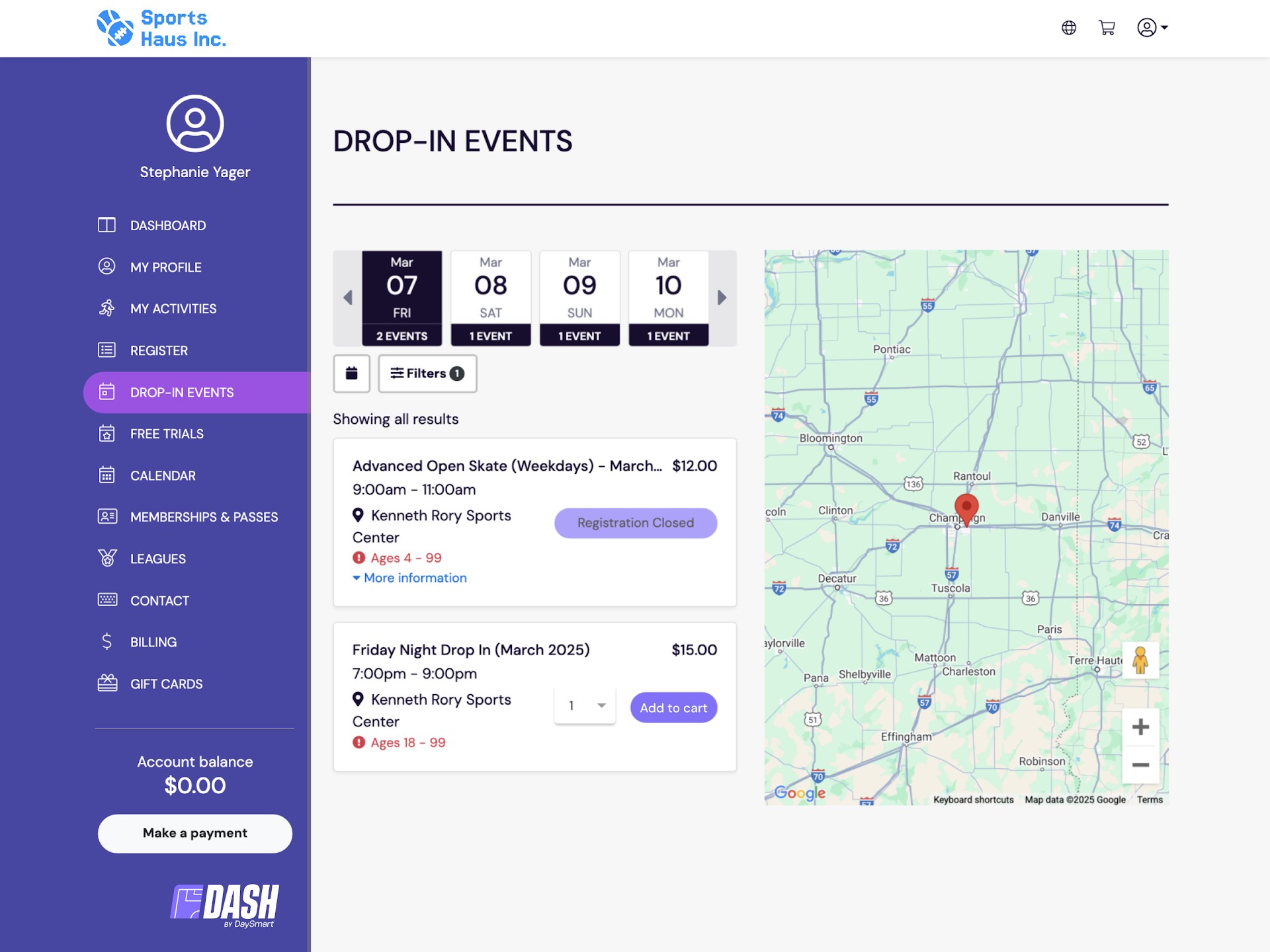
Responsive Scheduling Matrix: Dense multi-variable data (dates, locations, pricing, age tiers) architected into clear, filterable views that reduce cognitive load.
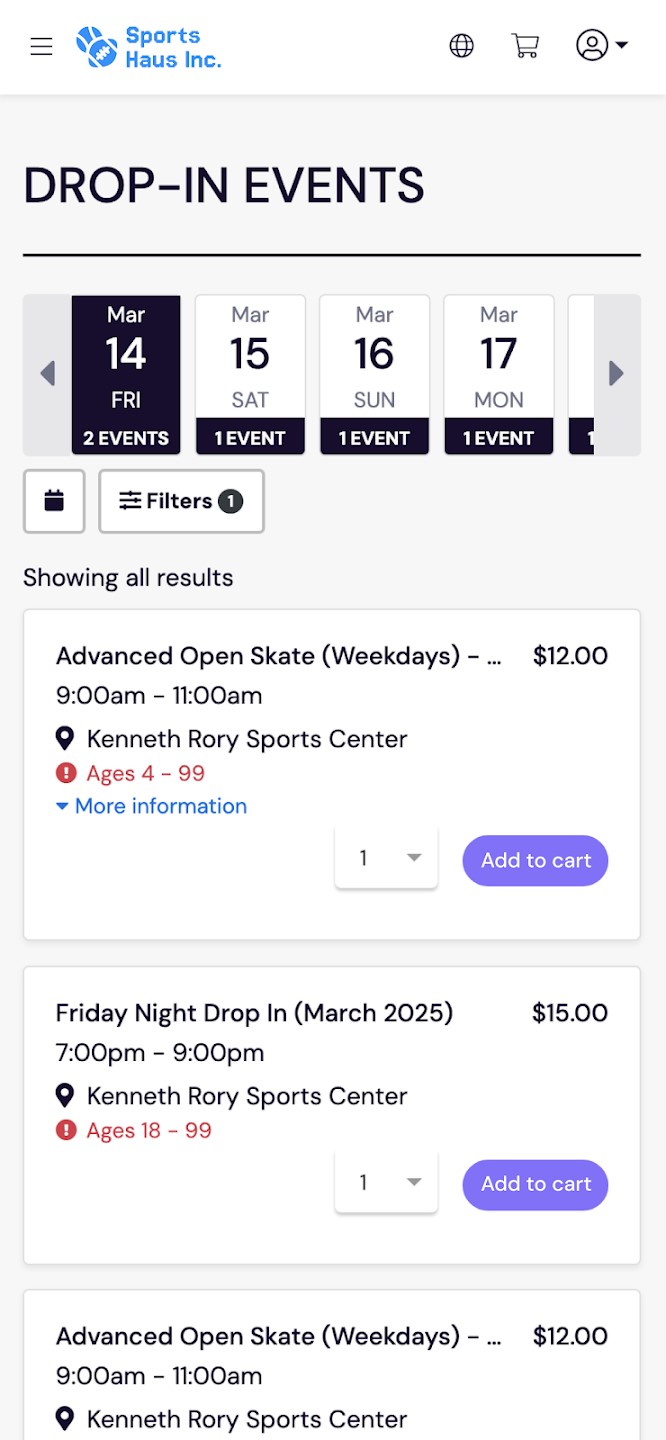
Mobile Card Stack & Theming: Complex desktop tables gracefully degrade into touch-friendly cards. UI elements map to dynamic CSS variables, inheriting partner branding without custom code overrides.
Technical Deep Dive: Multi-Tenant Architecture & Front-End Execution
Token-Based Brand Inheritance: To avoid manual CSS overrides across hundreds of facility tenants, all core UI components were mapped to dynamic CSS variables. When a tenant's brand colors load, the system inherits them into root-level tokens while automatically calculating luminance ratios to enforce strict WCAG 2.1 AA text contrast.
Fast Framework-Agnostic Rollout: Shipped modular, lightweight semantic HTML and CSS directly into the legacy environment. This stopped layout failures immediately and drove rapid conversion gains without waiting for a full back-end stack rebuild.
Impact & Results
- More Than Doubled E-Commerce Conversion: Core checkout completion increased from an industry baseline of 3% to 8.25%, outperforming benchmarks.
- +20% Surge in Mobile Adoption: Mobile traffic quickly became the primary booking channel for thousands of community members within the first quarter.
- 9% Reduction in Bounce Rates: Clear visual hierarchy and streamlined form validation prevented users from abandoning registrations.
- Foundation for Future Scale: Proving the business value of standardized components during this rollout created direct leadership alignment to build our platform-wide design system.

Jeff Grove
Founding Investor & Developer at Dash
"In my 11 years at Dash and 24 years at Microsoft, Daniel is the best all-around designer with whom I've worked... If I were to start a new, small software company, Daniel would be the first designer I would try to hire."
I worked with Daniel Sebree for 8 years at Dash where we built sports facility management software. In my 11 years at Dash and 24 years at Microsoft, Daniel is the best all-around designer with whom I've worked. He's not only an excellent designer, he also did some general development work for us at Dash as well. While his detailed designs, broad knowledge of HTML, CSS and JavaScript were valuable, the real value to our small team was his willingness to wear multiple hats and share knowledge to better educate the entire development team on all things design related.
In addition, Daniel really embraced what I think of as our team's motto, "strong opinions, loosely held." What I mean by that is Daniel would never hesitate to express his opinions, but he was always willing to listen to alternative ideas or to understand that maybe certain design elements we not practical for various reasons. It made working with Daniel a joy every single day we interacted. We were generally of the same opinion, but when we were not of same opinion, we always arrived at what I felt like was an excellent solution that was better for our being able to debate the issues productively.
One recent example was for a feature where we were updating our method to generate our contracts in HTML and PDF formats. My initial implementation of his design had some changes to some elements. I felt that it was more important to get the feature out quickly with the simplest possible approach to replace a poorly implemented feature. Daniel's opinion was that there were key elements missing in my initial implementation that were significant usability concerns. His position and reasoning were solid and he was standing up for end users and he convinced me his approach was best. End users were happy with the feature update and specifically called out his elements in the design as key parts of the update.
I was not only one of the developers at Dash; I was also one of the founding investors. If I were to start a new, small software company, Daniel would be the first designer I would try to hire. I highly recommend him.